
Updated April 22, 2026 with the latest data
Would you believe that the largest “industry” contribution to Canada’s GDP is real estate rental and leasing? – and that does NOT even count the actual construction of real estate.
This article shows you Canada’s GDP by industry, Canada’s exports and imports by product segment and importantly, Canada’s NET exports by product category. And it shows the percentage trade by country. Believe me, it’s an eye opener!
Which industries contribute the most to Canada’s economy? In terms of Gross Domestic Product (GDP) what are the percentages from oil and gas, real estate, construction, government services, forestry, farming, financial services and manufacturing etc.? The answers below might surprise or even shock you.
What portion of Canadian GDP do imports and exports make up? What products does Canada Import and Export? Which countries, other than the United States, are important trading partners of Canada? What products is Canada a net exporter of and what is it a net importer of? The sometimes surprising answers are provided below in a brief and graphical format.
Firstly, what is the meaning of GDP?
GDP or Gross Domestic Product refers to the total dollar value of recorded economic production within a country. It measures the final value of all goods and services produced. The GDP of a particular industry is (roughly) the value of its sales minus the costs of goods or services purchased from other entities. The GDP of a particular industry measures the economic activity directly generated by that industry. The GDP of a particular industry is not a measure of its profit or value added since it does not deduct the cost of labour from the value of sales nor does it deduct the cost of capital including interest payments on debt.
GDP is often criticized because it does not include the value of unpaid work or of unreported economic activities such as the “underground economy” or the value of “do-it-yourself” labour. Nevertheless, GDP is the best available figure for use in understanding the economy and the relative importance of each industry to the economy. There is one strange exception to the rule of not including unpaid and unreported economic activities. GDP includes a significant amount for the “imputed” rental value of owner-occupied houses. If you own the house or condo that you live in you probably never realised that it is considered to be contributing to GDP monthly by the “imputed” amount that it would rent for. Strange but true!
What is Canada’s GDP by industry or sector?
As of Q4 2025, Canada’s reported GDP per year, in 2025 dollars, was running at $3.279 trillion or $3,279 billion per year.
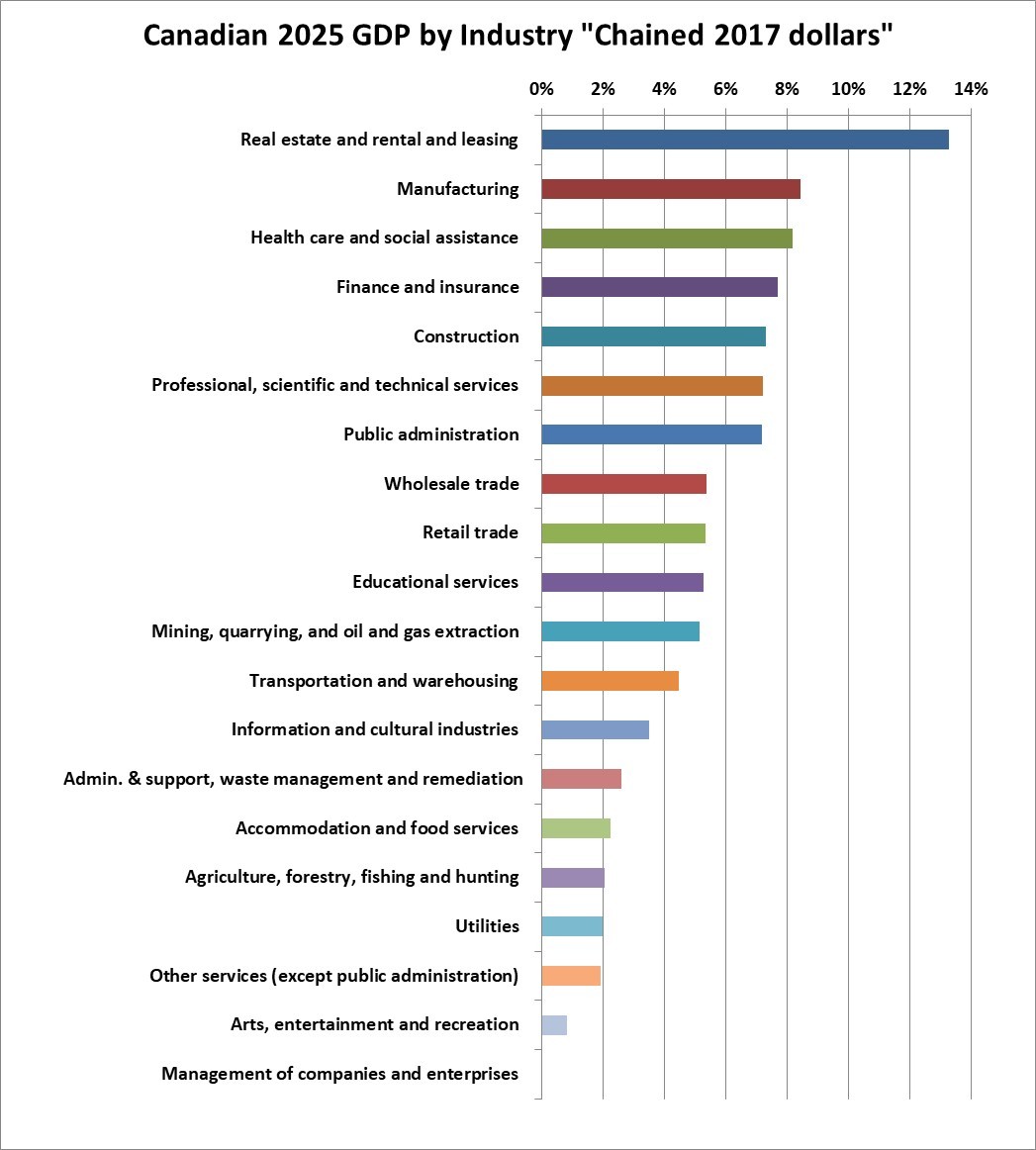
The following chart shows the percentage contribution of the various goods and services sectors to the total in 2025. Note however that this is based on something Statistics Canada calls 2017 chained dollars, which (I understand) basically assumes that there were no relative price changes among the sectors since 2017. I would prefer to use current dollars. However, for complicated reasons, Statistics Canada produces figures on GDP by industry in current dollars only on a three year lag basis. Chained dollars do a good job of measuring changes in volume or activity over time but may distort the relative contributions by segment in today’s dollars. This may be particularly true for commodity industries where price changes can be far different than the overall inflation level.
Data Source: Statistics Canada
https://www150.statcan.gc.ca/t1/tbl1/en/tv.action?pid=3610043403
The figures show that “Real estate and rental and leasing” is the largest segment of Canada’s economy at 13.3% of the total. This category (strangely) includes the “imputed” rental value of owner-occupied homes and that explains why this component is so very large. A large component here is the renting / leasing of real estate but it also includes auto and equipment leasing. Most retailers and office users rent their space. This category includes real estate brokers. Note that this category does not include constructing real estate! The high percentage related to the use of real estate (plus auto and equipment leasing) may seem high. But it includes the imputed rental value of owner occupied homes.
Manufacturing, while it may be lower than in years past, is still a very large portion of GDP and is the second largest component at 8.4%. Note that manufacturing includes process industries such as oil refineries, pulp mills and chemical plants.
Surprisingly, (Shockingly?) mining, quarrying, and oil and gas extraction has fallen down to the eleventh largest item at 5.3% of total GDP. The mining, quarrying and oil and gas extraction segment would rank higher in current dollars since oil prices were considerably higher in 2025 versus 2017. And, as illustrated below, energy (largely oil) is enormously important as Canada’s largest NET export by FAR.
Review the rest of the chart to see the composition of the Canadian economy and the percent contribution of different segments.
In total, goods-producing industries contributed for 25% of Canada’s GDP while service-producing industries contributed 75% of GDP. The public sector (which would be mostly or almost entirely service-producing) contributed 21% of the total GDP.
See the link to the source data just above to see the raw data if desired.
Who Consumes Canada’s GDP?
Canada’s 2025 GDP was consumed in the following fashion:
Personal Household consumption: 58.5%
Government consumption: 22.1%
Investment in non-residential structures machinery and equivalent 8.5%
Investment in residential buildings 6.3%
Investment in intellectual property and inventory 2.5%
Government Investment: 4.1%
Net Exports: (imports exceed exports) -2.3%
Total: 100%
When you hear that consumers “account” for most of Canada’s GDP, that does not mean that businesses account for little. In fact Businesses and (yes) government create the GDP and consumers consume the largest share. Government also consumes a large share but this is done to serve people (those same consumers) for example direct service in the case of education and health care and other direct services and indirect service in the case of police, the court, the army and other government services. This should not be considered surprising or alarming. Why else should things be produced except for consumption? (and for some investment to fuel future consumption).
A surprisingly large 22% of Canada’s GDP is expended on investment in (the creation of) longer lasting assets such as buildings (including houses) machinery, software and equipment rather than being consumed for immediate gratification. This includes replacing and upgrading worn out buildings and assets which may account for it being so high.
What does Canada Export?
As a country, and as of 2025, Canada imports goods and services that amount to $1,044 billion per year or about 32% of GDP. That would not be sustainable unless exports were at a roughly similar level, which, luckily, they are. Exports of goods and services in 2025 were $1,016 billion or about 31% of GDP. In a sense it can be said that every country that imports goods and services needs to export something to pay for those imports – unless the country collectively is to run down its savings or run up its debts to pay for imports. #UnitedStates with its large trade deficit.
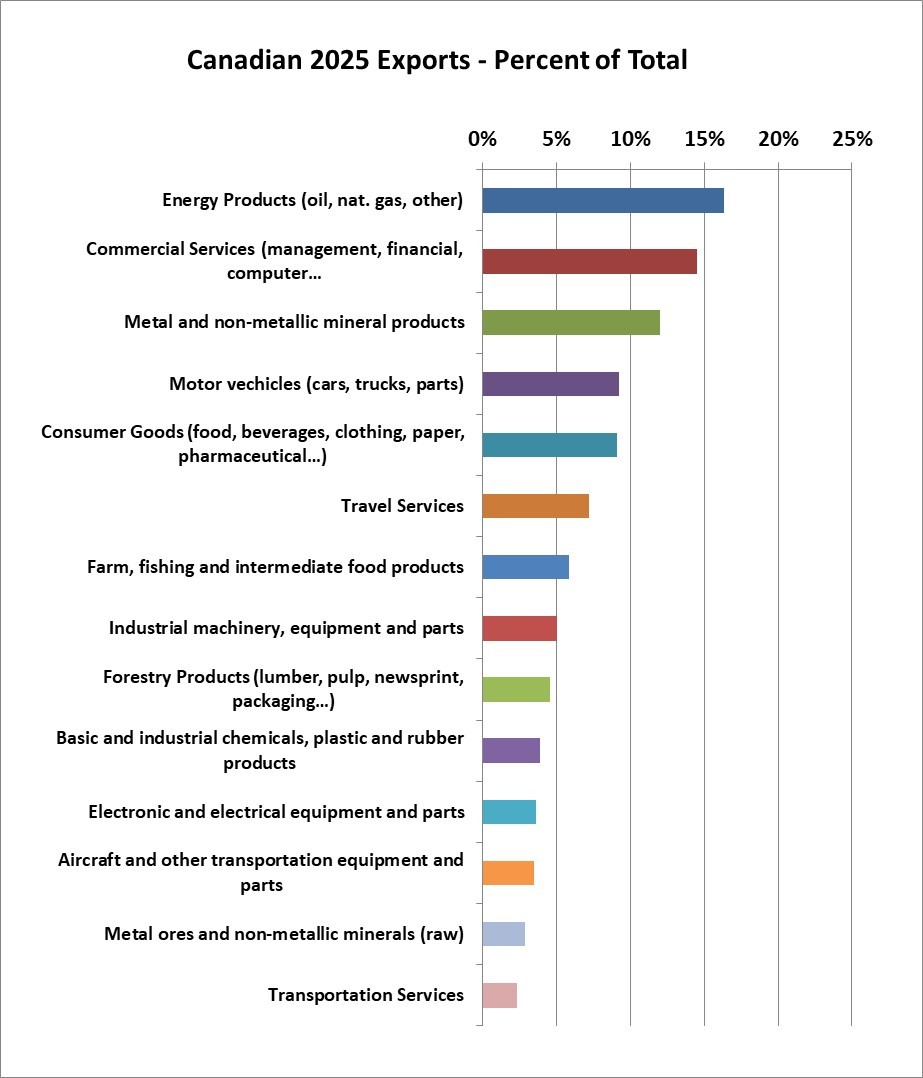
Here is a breakdown of Canada’s exports by category:
Data Source: Statistics Canada
Exports and imports of goods and services quarterly (choose current dollars, not chained 2017)
Canada’s largest category of exports is energy products at $162 billion or 16% of the total – crude oil is the great majority of this followed by natural gas then refined petroleum products and minor amounts of coal, electricity and nuclear fuel. The dollar value and percentage contribution of energy products may be noticeably higher in 2026 due to higher oil prices and due to natural gas LNG exports.
Commercial services which includes management services, financial services and information services is the second largest export category at $144 billion or 14.5% of the total. That’s not far behind energy products! Metal and non-metallic mineral finished products is the third biggest export category at $119 billion or 12%. Motor vehicles and parts are the fourth largest export segment at $92 billion or 9.2% of total exports. Consumer goods, perhaps surprisingly, is fifth largest at $91 billion or 9.1%% of the total.
Canada has a reputation for exporting relatively unprocessed natural resources. That is certainly true in regards to oil and metal and mineral ores. But most of Canada’s exports are not raw materials. For example, under forestry products, raw logs represent only 1% of that category.
To Which Countries Does Canada Export to (Excludes Services)?
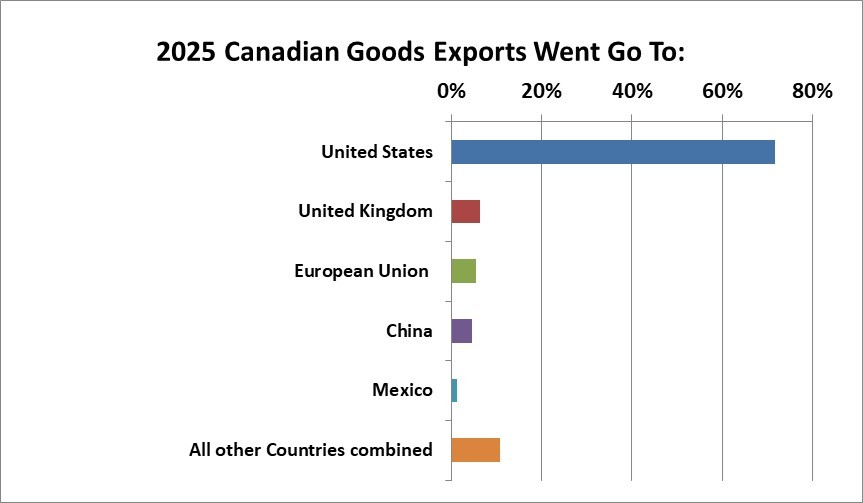
The answer to that question is alarming especially in light of the current tariff war:
Data Source, Statistics Canada
International merchandise trade for all countries and by principal trading partners, quarterly seasonally adjusted (multiply by four to annualise).
http://www.statcan.gc.ca/tables-tableaux/sum-som/l01/cst01/gblec02a-eng.htm (monthly)
Note that our data source does not include services in the exports-by-country data.
The United States accounted for the great majority of Canadian goods (merchandise) exports at $555 billion or a staggering 72% of the total. But this is down from about 75% in 2024. The United Kingdom is second at $50 billion or 6.4% of the total. The European Union collectively is the third largest export destination at $43 billion or 5.5% of the total. China at $35 billion represent about 4.5% of the total. Mexico, despite its proximity imports only about $9 billion annually of goods from Canada or 1.2% of Canada’s total exports.
Things may be changing and China is an important “customer” country for Canada. But the fact is, for now, when it comes to Canadian exports, the United States remains our number one export destination by far. Mexico, despite its proximity accounts for only $9 billion annually or 1.2%. Canada’s exports to all but a tiny handful of countries are almost insignificant. Treating the European Union collectively, you can literally count all of Canada’s important trading destination countries on the fingers of one hand. The extent of the reliance on exports to the U.S. is sobering and, given their increasing “America-First” rhetoric and policies, alarming. Some of the “other” countries may import more from Canada than Mexico does but Statistics Canada has not broken them out in our source table.
What Does Canada Import?
Canadian Imports by Category:
In 2025 Canada’s imports of goods and services at $1,044 billion were about 32% as large as its GDP.
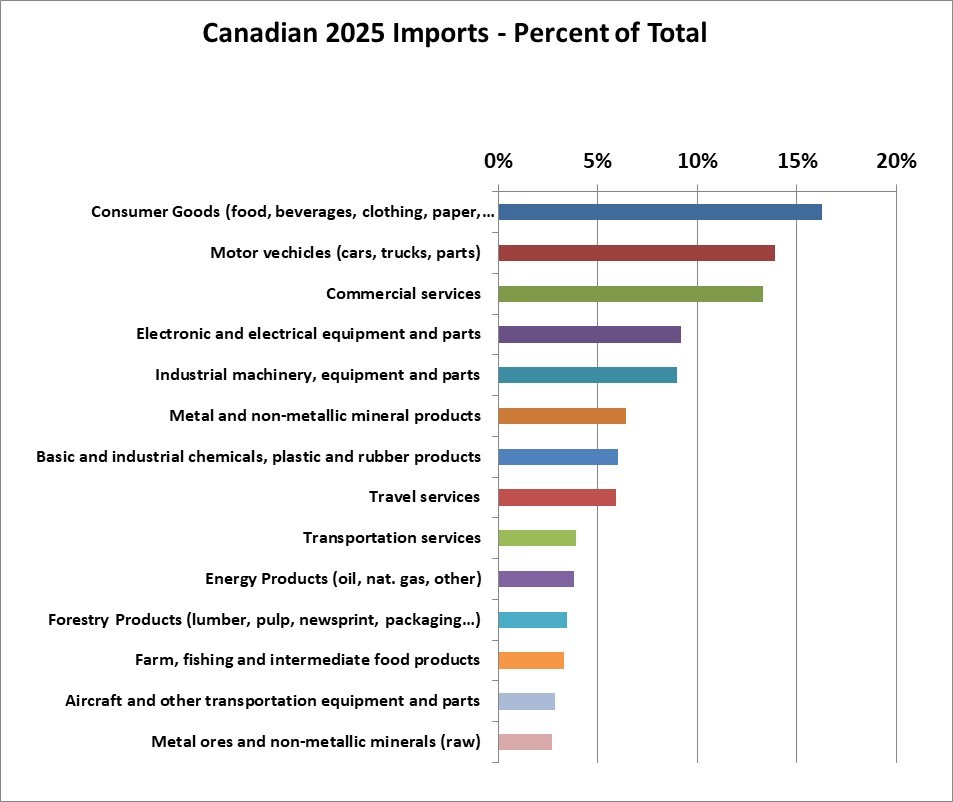
The following chart shows imports by industry segment as a percentage of total goods and services imports.
Data Source: Statistics Canada
https://www150.statcan.gc.ca/t1/tbl1/en/tv.action?pid=1210013401
The data indicates that consumer goods are Canada’s largest import category at $165 billion or 16% of the total. Motor vehicles and parts at $141 billion constituted 14% of total goods and services imports. Commercial services constituted $135 billion or 13% of the total.
From Which Countries Does Canada Import Goods?
Data Source, Statistics Canada
International merchandise trade
Note that our data source does not include services in the imports-by-country data.
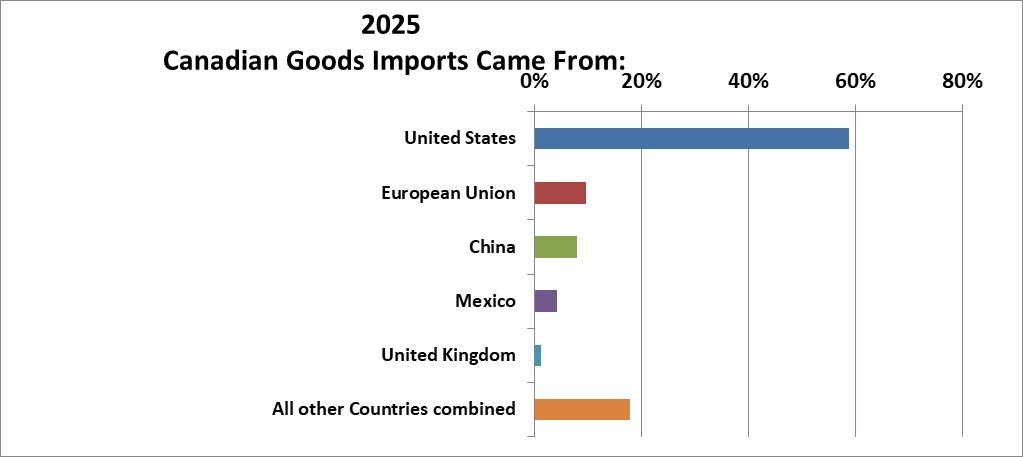
The United States accounts for $475 billion or 59% of Canada’s annual goods imports. The European Union collectively accounts for $78 billion or 9.7%. China accounts for $65 billion or just 8.1% of the total. Mexico accounts for for $35 billion or 4.3% and the U.K for $11 billion or just 1.3%. The remaining $144 billion or 18% is spread widely around the globe. Most of the other countries in the world are insignificant to Canada in terms of imports. But there may be some countries from which Canada imports more than Mexico and certainly the U.K. This is the way our data source breaks down the countries.
For Which Products and Services is Canada a Net Exporter and For Which a Net Importer?
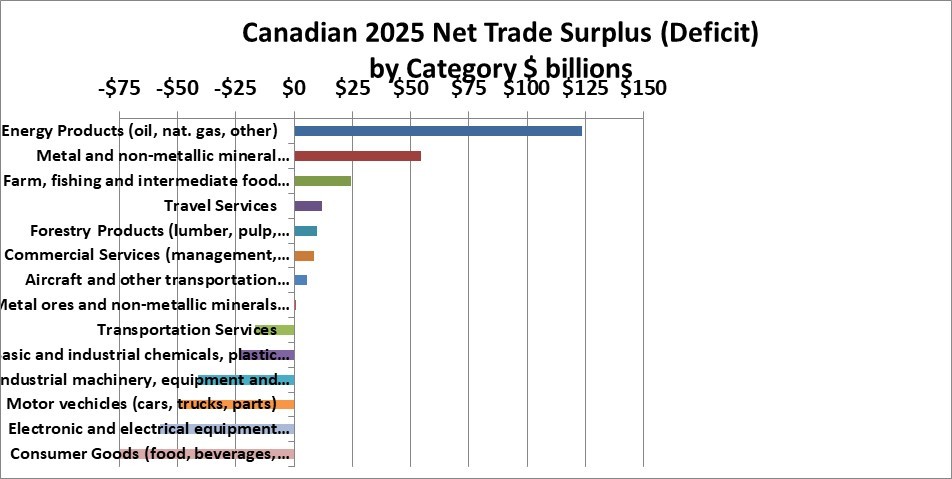
Energy – largely crude oil – is Canada’s largest NET export (exports minus imports) at $124 billion. And it’s “no contest”. That’s 2.3 times larger than the next highest net export category which is “metal and non-metallic mineral products” – which includes steel and aluminum products at $54 billion. Oil is “bringing home the bacon” to this country and in a sense provides the dollars to pay for the things that Canada imports. Metal products, farm, fishing and intermediate food as well as forestry also bring home some bacon to this country. In 2026 with higher oil prices, Oil is going to be even more so the largest net export by far.
Canada is a net exporter of commodities including notably energy products, metal & mineral products, farm, fishing & intermediate food products, and forestry products.
Canada is a net importer in most manufactured and finished goods categories including consumer goods, motor vehicles & parts, industrial machinery, and electronic & electrical equipment. Given all the support to that industry, it might be a surprise to see that motor vehicles are a large net IMPORT category for Canada.
Canadians don’t actually operate as one giant sort of “team”. But it can be argued or observed from this data that, for the country as a whole, the net exports of energy (oil) in particular and to a lesser extent other commodity products are what pay the bills to allow the country to be very much a net importer of consumer and manufactured goods.
END
Shawn Allen, CFA, CPA, MBA, P.Eng.
President, InvestorsFriend Inc.
Article originally created November 3, 2007, the latest annual update was April 22, 2026.
Dear reader: Consider joining our free newsletter list to keep in touch. I hope you will agree that my content is clear, trustworthy and useful. I will never abuse your email address. I only send out to this list about once a month or less.